
 Read on Twitter
1/ The concept of "psychiatric disorders as disorders of sense-making: disorders of the way that individuals make sense of themselves and the world around them" seems valuable for science and clinical practice. However, there are points of debate  https://www.psychiatrictimes.com/view/sense-making-enactive-turn-psychiatry-sanneke-de-haan-phd
https://www.psychiatrictimes.com/view/sense-making-enactive-turn-psychiatry-sanneke-de-haan-phd
2/ As @awaisaftab points out, the distinction between psychiatric vs somatic disorders, as "primary and secondary disorders of sense making" requieres discussion. The division between neurological vs psychiatric disorders perhaps is not fundamental, but rather practical
3/ de Haan argues that somatic disorders consist of local alterations that can add to global sense problems, while psychiatric disorders are global sense problems that can involve local neurological processes, but are not products of brain alterations, however
4/ In the practice of neuropsychiatry, there are many cases in which it is difficult to distinguish between primary psychiatric disorders vs psychiatric disorders of neurological origin. This happens often in the fields of #neurodegeneration or #autoimmune #psychosis, and
5/ as an example, today we attend a 44 year old woman, abandoned by her husband with three children in the middle of the #pandemic, who had an acute onset of affective and cognitive abnormalities, hallucinations and catatonia. MRI shows a cerebral venous trombosis.
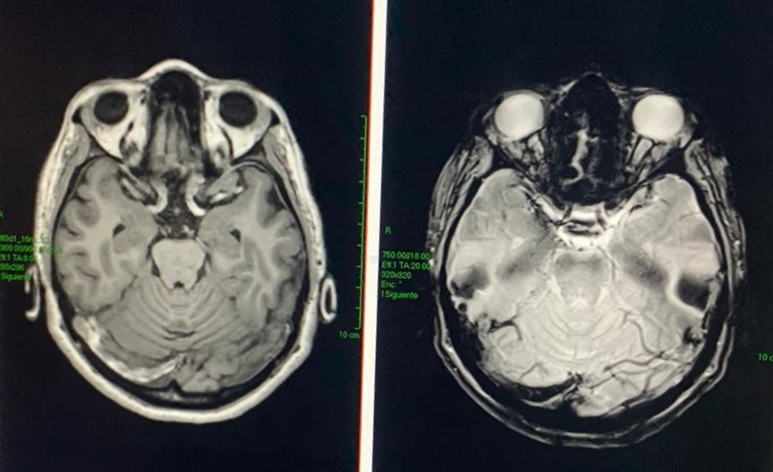
6/ Even when we can demostrate a neurological abnormality, it's not always clear if it's sufficent to explain the psychiatric disorder. In order to harmonize the enactive turn proposed by de Haan with the lessons of clinical science, a discussion of causality is needed
7/ Sometimes, psychiatric abnormalities are fully explained and resolved by a neurologic approach (this often happens in antiNMDAr #encephalitis). But in many cases, the neurologic disease is part of the multicausality leading to mental symptoms; besides
8/ Even in neurological patients, as Germán Berrios said, the cultural, family and biographical background, as well as the context, may be involved in the configuration of the mental symptom, which may not be totally devoid of "meaning", although it may have a "somatic" cause
9/ On the other hand, the neurobiological abnormalities often observed in "primary psychiatric disorders" are also important as parts of the big picture of causality, even if the main causes of a patient's symptoms are psychosocial, as happens in PTSD. To sumarize
10/10 I don't believe that a division between primary and secondary disorders of sense making is essential or applicable to most cases we deal with in neuropsychiatry, because "necessary and sufficient causes" are infrequent -the best approach in most cases is multi-causality.


